County 101
“What does a county commissioner even do?”
I get asked this question more than anything else, and it’s one of the least-understood roles in Texas.
Almost nobody thinks about county government, but interacts with it regularly. It’s what manages most of your courts, the jail, your elections, and one of the lines on your property tax bill.
Here’s what the office of County Commissioner is responsible for, what it’s not, and what it means to you.
What does a Commissioner do? Is it like Commissioner Gordon in Batman? Sadly, no. We don’t even get a bat signal.
A city can do anything the law doesn’t forbid. A county can only do what the law specifically allows.
Plano, Allen, Dallas, Frisco, etc. are home-rule cities, which can pass essentially any ordinance they want, as long as it doesn’t conflict with state or federal law (Tex. Const. art. XI, § 5).
A commissioners court works the other way around. It can only exercise the powers the Texas Constitution and the Legislature have specifically granted it (Tex. Const. art. V, § 18; Tex. Loc. Gov’t Code ch. 81). If the statute doesn’t say the county can do it, we can’t.
In a nutshell, cities are constrained by permission denied, while counties are constrained by permission granted. When the county is missing a tool, only the Legislature can add it. As we’ll see, that’s actually a big part of the job.
For the Stranger Things fans: I liken county government to the Upside Down. Same town. Flipped rules.
Five votes. That’s the whole government.
The Commissioners Court is kind of like the city council of the county, and made up of a County Judge elected countywide, and four Commissioners, each elected from a precinct, and each serving four-year terms. That applies to each of the 254 counties in Texas.
Each member gets one vote. The County Judge presides but has no veto. Three members make a quorum (Tex. Loc. Gov’t Code § 81.006(a)), and a simple majority decides nearly everything including the budget, contracts, appointments, bond elections, and policy.
One exception worth knowing: the court can pass a tax only when at least four members are present, and only if at least three vote yes (§ 81.006(b)–(c)).
The office is partisan, so elections are in November of even-numbered years (during Presidential elections and midterm elections). Terms are staggered so that two commissioner seats are on the ballot each cycle, so the court never turns over all at once. The County Judge, Precinct 2, and Precinct 4 (for which I’m running) are on the ballot this November.
- 5 Members
- 1 Vote each
- 4 Year terms
The county’s power is a budget and a tax rate.
Nearly everything a commissioner can do for you runs through money.
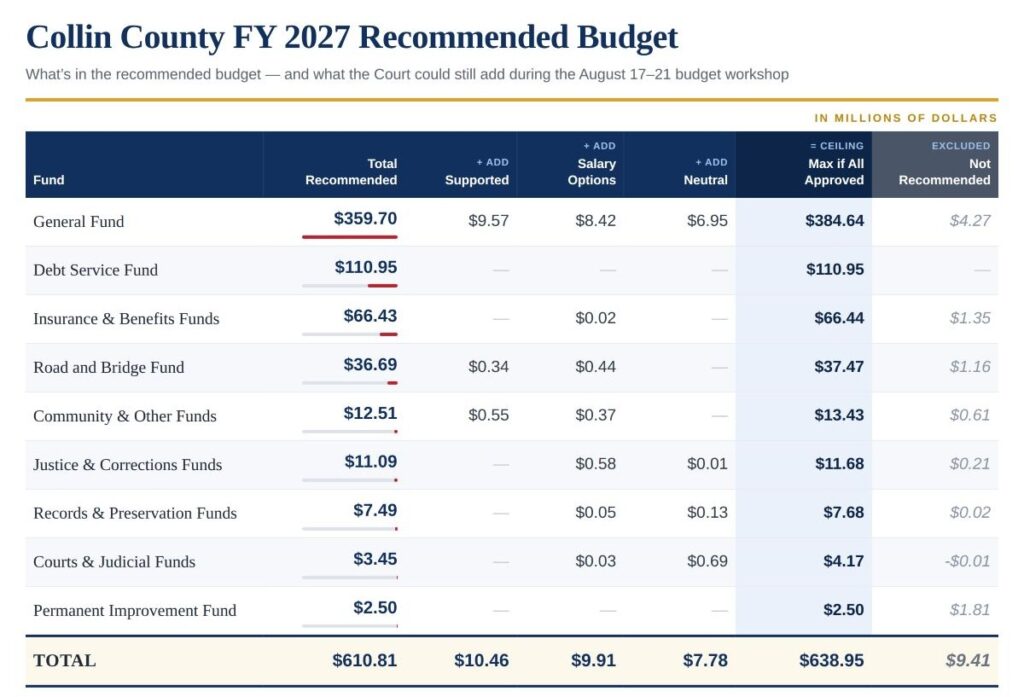
- The budget. The court funds every county department, including the staffing of independently elected officials like the Sheriff, the District Attorney, and the County Clerk. But it has no say as to how any of them manage their office. It decides what the Sheriff has to work with. The budget for the year that just began October 1 is more than $600 million.
- The tax rate. The county rate is about 15 cents per $100 of taxable value, which is roughly $745 a year on the median homestead. Your city, school district, and Collin College each set their own rates on the same bill. Property Taxes
- Contracts. Only the commissioners court can approve one.
- Salaries and benefits for county employees are set by the commissioners court.
- Bonds. B-O-N-D is a four-letter word, but it’s the proper way to capitalize long-lived assets. In 2023, county voters approved $683 million in bonds, including $380 million for roads and bridges. We’ll vote on $817.5 million more in this midterm election. (Certificates of obligation, a different instrument, need no election unless enough voters petition for one.) Property Taxes
- Abatements and development agreements under Chapter 312 of the Tax Code and Chapter 381 of the Local Government Code. Smart Growth & Development
Roads and Bridges in Unincorporated areas.
County Commissioners are responsible for roads and bridges outside city limits, but in Precinct 4, we have almost none.
County road authority, subdivision platting, and septic review apply to unincorporated land, outside a city’s limits. Collin County runs those roads as one countywide system through its Public Works department.
Precinct 4 is almost entirely inside city limits: Plano, Allen, and the Collin County portion of Dallas. The unincorporated remainder totals about a tenth of a square mile.
Votes to maintain roads and plat subdivisions are for areas outside Precinct 4, so representing Precinct 4 is overwhelmingly about the countywide budget, the tax rate, countywide services, and working across city lines.
The county plays an important role in how you get around. It helps fund major thoroughfares and regional corridors that cross city boundaries, often in partnership with cities and the state. Transportation
Counties are adjuncts to the state government. They also provide services in unincorporated areas (the uncharted wilderness) that cities ordinarily provide inside their borders, such as law enforcement, building permits, and roads.
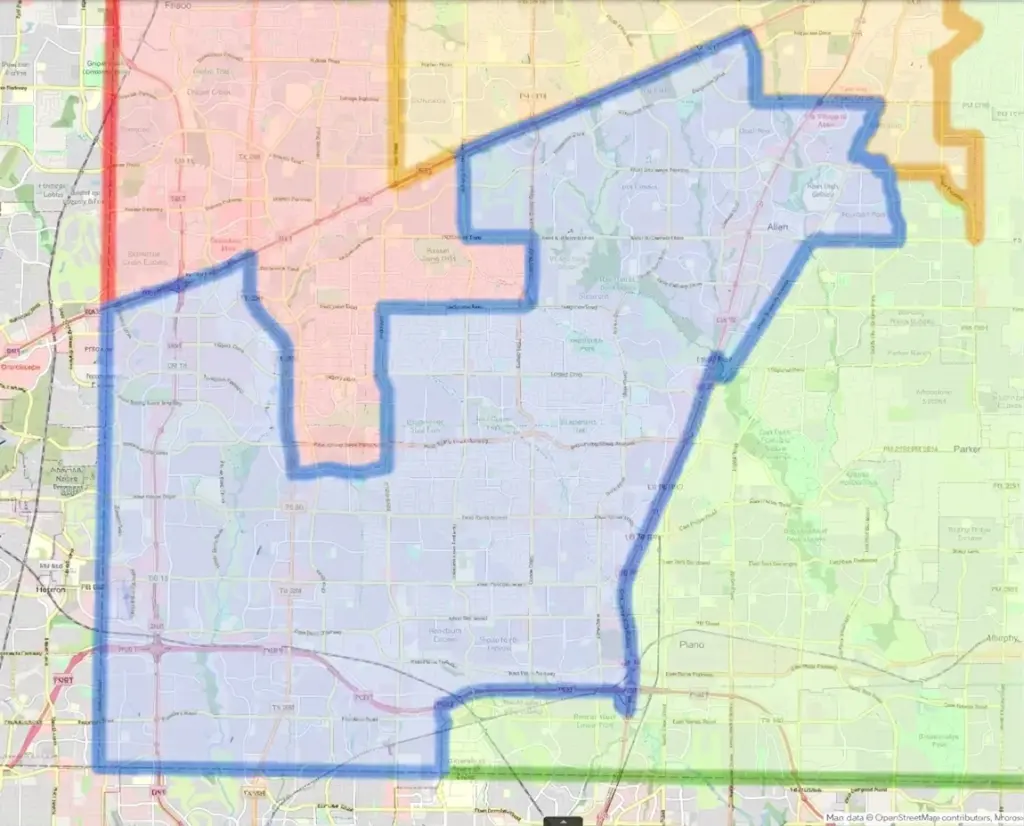
Who Can Vote for Me
Collin County Commissioner, Precinct 4
Precinct 4 represents the majority of Plano and Allen, as well as Far North Dallas. Our communities are very similar and share the same challenges. I addressed those challenges for six years on Plano City Council and will continue to do so diligently.
County services don’t stop at the city limit.
Cities police their streets. The county runs the system those cases go into — and a lot more besides.
The Duties
What a Commissioner Does
County government touches nearly every part of daily life. Here are the core functions the Commissioners Court is responsible for.
Fund County Services
- Law enforcement
- The court system
- County health services & LifePath
Revenue & Records
- Tax collection
- Elections
- Public records
Infrastructure & Growth
- Roads & infrastructure in unincorporated areas
- Transportation planning
- Building permits in unincorporated areas
The Commissioners Court
- Setting the county budget
- Passing Court Orders under state law
- Fiscal responsibility & partnerships
Public safety and justice
The Sheriff’s Office and the county jail. Constables. The District Attorney. The county and district courts. The Medical Examiner. Public Safety
Records and administration
Deeds and marriage licenses through the County Clerk. Vehicle registration and property tax collection through the Tax Assessor-Collector.
Elections: the framework
The court adopts the voting system used countywide (Tex. Elec. Code § 123.001), sets early-voting locations (§ 85.062), decides whether the county uses countywide vote centers, establishes the central counting station, funds the elections operation, and canvasses the results. That’s a lot.
Day-to-day administration belongs to the Elections Administrator, who is appointed by the County Election Commission (which I served on): the County Judge, the County Clerk, the Tax Assessor-Collector, and the county chairs of both major parties (§ 31.032). Election judges come from lists the party chairs submit.
Health and behavioral health
The county provides health care to qualifying low-income residents, runs public health services, and LifePath Systems, the county’s designated authority for mental health and substance use services. Since a significant number of inmates at the county jail have a mental health disorder, LifePath staff is dedicated to the jail, and a dedicated medical and mental health facility at the jail is nearing completion.
Appointments
The court appoints department heads and fills vacancies in most elected county offices such as the sheriff, county clerk, and even the county judge until the next election (Tex. Loc. Gov’t Code § 87.041). The exception: when a commissioner’s seat has a vacancy, it’s filled by the County Judge (§ 87.042).
Redistricting
After every census, the court redraws its own precinct lines, along with justice of the peace and election precinct boundaries. The next round follows the 2030 Census.
What the Commissioners Court can’t do.
Not “shouldn’t” — can’t.
- Zone, permit, or approve site plans inside a city. Those decisions belong to the city councils.
- Run city streets, parks, libraries, or code enforcement.
- Touch school districts. The county has nothing to do with school districts, but works in partnership.
- Set your appraisal. The Collin Central Appraisal District does that. Its board has five members appointed by local taxing units, of which the county is one of many, and three elected by voters, which are on your ballot this November. Property Taxes
- Direct independently elected officials. The court funds—not runs—the Sheriff and the District Attorney.
- Make state law. That’s the next bit.
When We’re missing a tool, only Austin can add it.
Because a county can do only what the Legislature allows, changing what the county can do requires a change to state law.
When that’s the case, we can sit around and hope, or start lobbying the legislature.
County government is a critical connective tissue between the state and local government, so in this job, relationships aren’t social, they’re structural. Working relationships with legislators and state agencies, and with our congressional delegation for decisions that run through Washington, are how a commissioner gets anything changed that current law doesn’t allow.
Here’s a live example. In 2017 and 2019, the Legislature ended cities’ power to annex land without the owners’ consent. As a result, most growth is beyond city limits where the county has planning authority but no zoning authority. Only the Legislature can close that gap. Smart Growth & Development
I’ve done this kind of work even before I was elected to Plano City Council. Then on city council, with no authority over any other city, I started the effort to reform DART, which led to a seven-city coalition. Transportation
Counties can’t pass ordinances like cities–they can only pass Court Orders if allowed to by state law. This also requires strong working relationships with the legislature.
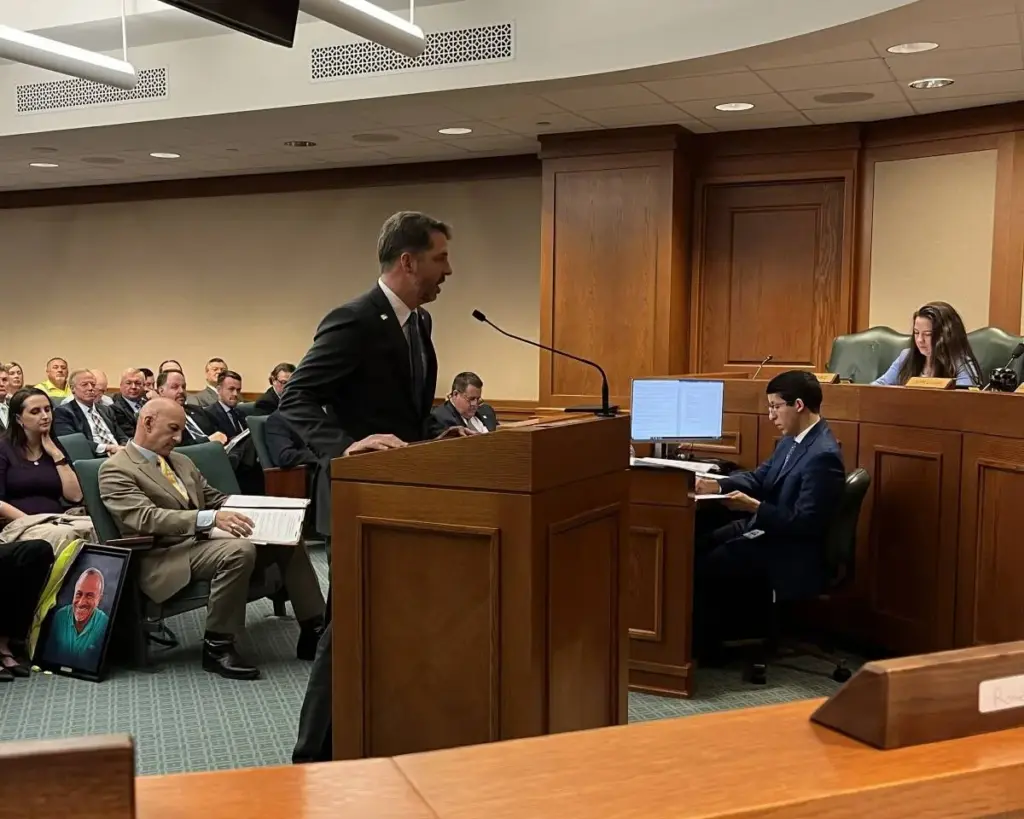
An informed voter is better equipped to hold elected officials accountable, which is why I’ve spent years informing the public and teaching Constitution 101 and Property Tax 101.
Want to see where I stand? Check out my Issues pages.